Full Spatial Computing Gets Lighter as URXR One Heads to Kickstarter
Unseen Reality is excited to announce that URXR One, its 93-gram spatial display glasses, will launch on Kickstarter on August 4, 2026. The campaign will offer URXR One at a $799 Kickstarter special ahead of its $899 MSRP, with shipping targeted for mid-October 2026.
A Different Kind of Display Glasses
Lightweight display glasses have typically focused on mirroring a screen. More capable mixed-reality systems can provide room-scale tracking, video see-through, and spatial interaction, but often place several hundred grams of hardware on the wearer’s head.
URXR One brings those capabilities together in a glasses frame built for everyday use. It is the first pair of lightweight MR glasses built around mini pancake optics, creating a new option for people who want more spatial capability without moving into a full-sized headset.
Each eye pairs a 1.03-inch Micro-OLED display with a mini pancake optical stack, running at 2448 x 2064 pixels. Together, the displays provide roughly 5K dual-eye resolution, approximately 36 pixels per degree, and a 90 Hz refresh rate.
The 90-degree diagonal field of view measures approximately 80 degrees horizontally by 56 degrees vertically. Mini pancake optics fold the light path to keep the display module thin while helping the picture remain clear and solid across more of the screen. Instead of constantly searching for a narrow viewing area, wearers can look naturally toward the edges and corners.
A dedicated Spatial Processing Unit handles room tracking and video see-through directly on the glasses, leaving the connected device free to run applications, games, and video. Dual-camera SLAM and a 1000 Hz IMU support native 3DoF and 6DoF tracking, with listed drift under 1 cm. A button on the glasses lets wearers switch between a screen that follows their orientation and a spatial display that stays anchored as they move around the room.
URXR One’s video see-through system runs at 2328 x 1728 resolution and supports 90 frames per second. A 90-degree field of view and listed latency under 10 milliseconds keep the room, desk, keyboard, hands, and other people visible around the virtual screen.
One Big Screen or a Full Spatial Canvas
URXR One offers two ways to begin:
Bypass Mode - Connect a compatible USB-C DisplayPort device and begin using one large mirrored screen with no companion application required. The display can be resized from laptop-sized to 200 inches and locked in space while the room remains visible.
URXR Connect - Open a broader spatial canvas with multiple virtual screens, a panoramic wide layout, hand-gesture control, immersive environments, and a private cinema mode for video.
For someone who simply wants a better screen, URXR One can bring a movie to the couch, give a handheld game more room, or create a private display during a flight. The screen remains visible only to the wearer, keeping work and entertainment away from nearby eyes.
Writers, developers, editors, designers, and other creators can spread familiar applications across multiple virtual screens without carrying a monitor setup. That can mean a triple-screen workspace at a coffee shop, code and documentation arranged side by side at an airport, or a wide canvas for focused work wherever a laptop can go.
The content still comes from the devices and applications people already use. URXR One gives it more room.
Built to Stay Light
The frame and foldable temples are made from magnesium-alloy AZ91D, selected for its strength-to-weight ratio. At 93 grams, URXR One keeps its center of mass behind the nose bridge so the glasses balance on the face instead of pulling forward.
Wear detection, an ambient-light sensor, a magnetometer, four forward-facing cameras, a six-axis IMU, and a four-microphone array are built into the glasses. Custom prescription lens inserts are supported, and the IPD can be adjusted manually from 58 to 68 mm.
“We're not building a better headset. We're building the first spatial computing glasses you can truly wear all day. Every design decision starts with the same question: can someone forget they're wearing this?” said Edward Zhou, founder and CEO of Unseen Reality.
Compatible laptops, tablets and Windows handhelds, including Steam Deck, can generally power URXR One directly over USB-C. Phones require the optional URXR Power Hub for power and video pass-through.
The pocket-sized 10,000 mAh Power Hub weighs 215 grams, powers the glasses, passes video through, and can slow-charge the connected phone over a single USB-C connection. It provides more than three hours of use and will be available as a $69 Kickstarter add-on, shipping separately with a USB-C cable.
Nintendo Switch setups require the Power Hub and a compatible third-party display adapter. The adapter is not included.
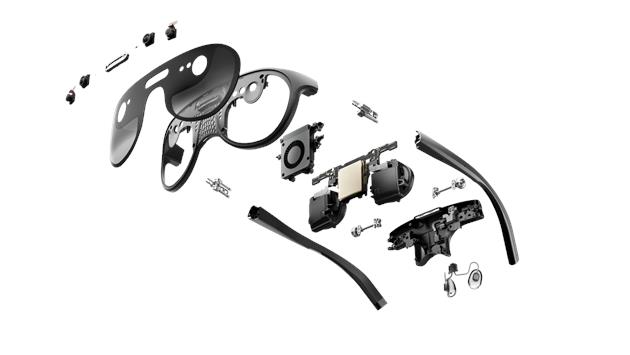
What Makes URXR One Different
First-of-Its-Kind Mini Pancake Optics - URXR One is the first pair of lightweight MR glasses built around mini pancake optics, helping the picture remain clear and solid across more of the display.
High-Resolution Micro-OLED Displays - Each eye uses a 1.03-inch Micro-OLED panel running at 2448 x 2064 pixels, providing roughly 5K total resolution, approximately 36 PPD, and a 90 Hz refresh rate.
A Wide 90-Degree Field of View - The display measures approximately 70 degrees horizontally by 56 degrees vertically, giving games, movies, documents, code, and multiple applications more usable space.
Spatial Processing on the Glasses - A dedicated chip handles spatial tracking and video see-through without placing the spatial-processing load on the connected device.
Native 3DoF and 6DoF Tracking - Dual-camera SLAM and a 1000 Hz IMU allow screens to follow the wearer’s orientation or remain anchored in the room, with listed tracking drift under 1 cm.
High-Fidelity Video See-Through - A 2328 x 1728 wide-angle view runs at 90 frames per second with listed latency under 10 milliseconds.
One Screen or a Full Spatial Canvas - Bypass Mode provides one mirrored screen up to 200 inches with no companion app required. URXR Connect adds up to three virtual screens, panoramic layouts, hand controls, immersive environments, and private cinema mode.
A Balanced 93-Gram Frame - Magnesium-alloy construction and a center of mass positioned behind the nose bridge help the glasses remain light and balanced on the face.
Built Around Familiar Devices - URXR One works with compatible laptops, phones, handhelds, and console setups through USB-C DisplayPort Alt Mode. The optional Power Hub adds power and video pass-through for phones, tablets, and other supported devices.
Working Hardware People Have Already Worn
URXR One has reached the engineering-prototype stage and made its public debut at AWE 2026. Attendees tried working hardware on the expo floor, including multi-screen workspaces, room-scale tracking, hand-gesture control, video see-through, immersive environments, screen resizing, 3D model viewing, and 360-degree video playback.
Independent hands-on coverage has highlighted the 93-gram form factor, spatial capabilities, display quality, and comfort.
Unseen Reality was founded by Edward Zhou, who holds a PhD in optics and electrical engineering from Cal Tech and has approximately a decade of experience in display and optics research and development for advanced headset and AR/MR programs. The company’s core team works across chip protocols, optics, displays, electrical engineering, industrial design, and software.
Kickstarter Launches August 4
URXR One will launch on Kickstarter on August 4, 2026, with a $799 Kickstarter special and targeted shipping beginning in mid-October 2026. The expected MSRP is $899.